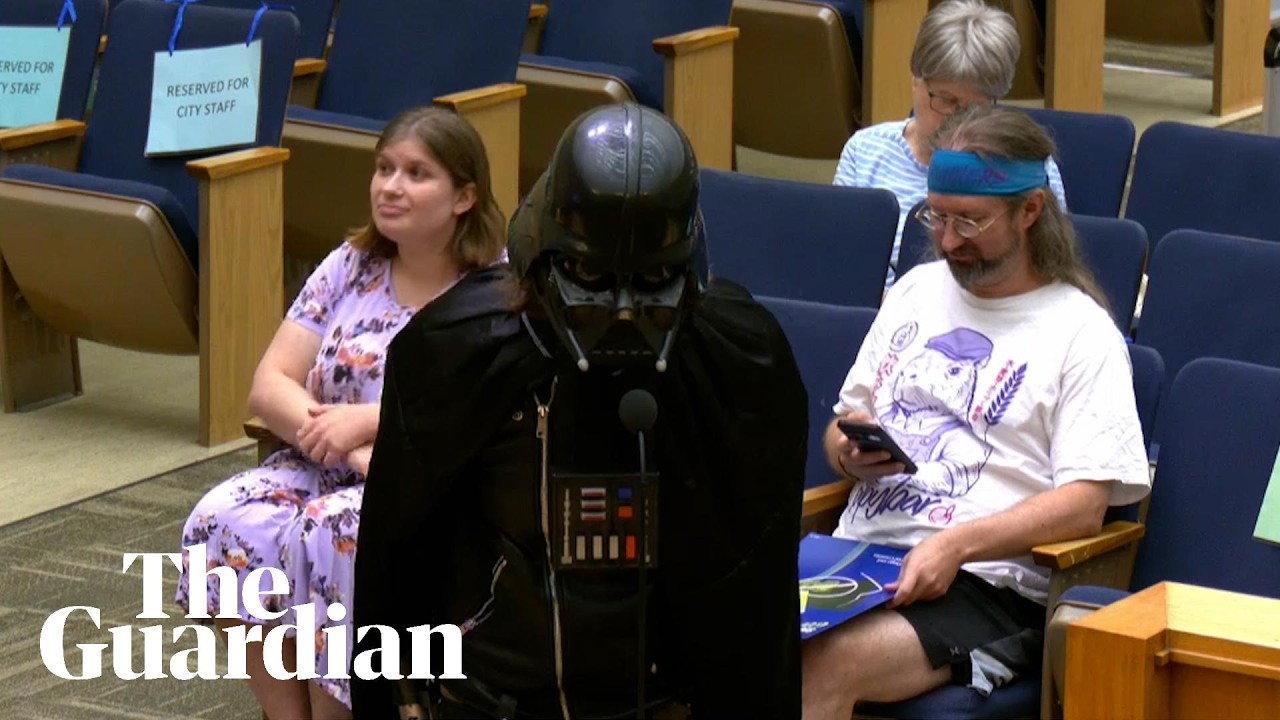
Space Satire: Darth Vader vs. The Surveillance State

""I find this council's lack of faith disturbing.""

@ManChan-w5p• 1mo ago
19.8k

Space Satire: Darth Vader vs. The Surveillance State

This deeply surreal clip captures a citizen addressing a city council meeting while fully cosplaying as Darth Vader, the iconic antagonist of the Star Wars franchise. The subject of the meeting is the implementation of Flock Safety cameras—a highly controversial mass surveillance technology. Rather than delivering a standard, impassioned plea for civil liberties, the speaker employs a brilliant, high-effort routine of reverse psychology. Speaking entirely in character, he aggressively advocates for the cameras, arguing that the "Emperor" needs this technology to track "rebel scum," stalk former partners, and fill detention centers with free prison labor. The absolute deadpan commitment to the bit perfectly highlights the dystopian reality of constant civic surveillance, making the council's actual political double-speak sound utterly absurd by comparison.

The Community Reacts: The Dark Side of Local Politics

The internet immediately recognized the brilliance of using extreme theatrical villainy to expose actual government overreach. Filtering through the political commentary, these curated comments perfectly deconstruct why the satirical performance was so highly effective:

  • The Honest Sith: Hero commenter @Nafebutuoy39 pointed out the tragic irony of the performance: "The worst part is he's being more genuine than the politicians". By openly embracing the villainous potential of the technology, the cosplayer strips away the polished, bureaucratic PR language usually used to sell mass surveillance to the public.

  • The Cinematic Callback: Hero commenter @ManChan-w5p perfectly adapted the Sith Lord's one of the most famous movie quote to fit the municipal setting: "I find this council's lack of faith disturbing.". It masterfully bridges the gap between a high-stakes space opera and the incredibly dry reality of local government proceedings.

  • The Tactical Approach: Selected commenter @kingbenjithegreat6195 appreciated the underlying rhetorical strategy: "The reverse psychology is genuinely genius". Instead of getting angry and being dismissed as a crank, the speaker forces the council to listen to a mirror reflection of their own policies taken to their logical, terrifying extreme.

  • The Wardrobe Technicality: Selected commenter @Steve-id5qx delivered a classic internet compliment with a twist: "Not all heroes wear capes, but this one does.". It playfully acknowledges that while Vader is universally recognized as a symbol of evil, the citizen beneath the helmet is performing a vital civic duty.

  • The Ultimate Medium: Selected commenter @AlexanderMastrian summarized the power of the performance: "Sometimes satire is the best critique.". It proves that political theater, when executed with enough commitment and absurdity, can cut through bureaucratic noise far more effectively than traditional debate.

The Technology of the Empire: How ALPR Networks Operate

To fully understand why this satirical performance resonated so deeply online, one must look at the actual mechanics of the technology being debated. Flock Safety cameras are a modern iteration of Automated License Plate Readers (ALPR). Unlike traditional traffic cameras that only trigger during a speeding violation, ALPR systems act as an always-on dragnet. They utilize advanced optical character recognition (OCR) and machine learning algorithms to capture and catalog every single passing vehicle, recording the license plate, vehicle make, model, color, and precise timestamp.

The speaker's hyperbolic joke about tracking "rebel scum from playground to playground" touches on a very real, documented privacy concern. Because these camera networks are often interconnected across multiple municipalities and states, they create a centralized, searchable database of civilian movement. When deployed in high densities, these systems allow operators to retroactively map a citizen's daily routine—from their workplace to their doctor's office, to their place of worship—without requiring a traditional judicial warrant.

Furthermore, the cosplayer's specific, unsettling joke about needing the cameras to "stalk my ex-girlfriend" highlights the most critical flaw in mass surveillance architecture: the human element. The centralized databases that house ALPR data have historically been vulnerable to abuse, where individuals with administrative access have utilized municipal technology for personal vendettas or unauthorized tracking. By dressing as a literal space fascist to demand more cameras, the speaker masterfully exposes the inherent dangers of building a turnkey surveillance apparatus. He essentially forces the local government to reckon with the fact that once the infrastructure for absolute control is installed, it is only one bad administration away from becoming an actual empire.

Do you find this post helpful?
Comments:
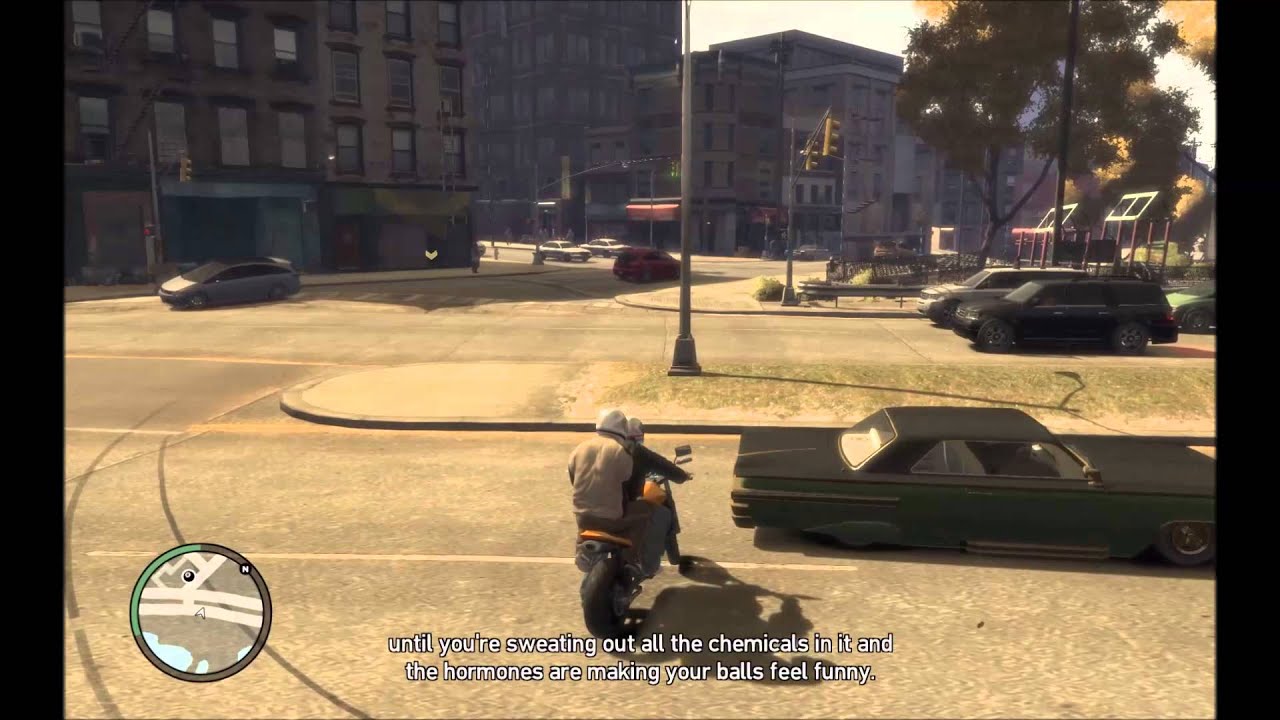
Niko Bellic Describes America in Grand Theft Auto IV

""Everything is just advertising with nothing to back it up" 2008 rockstar describes 2021 rockstar"

@MayYTlive• 4y ago
25.7k

Niko Bellic Describes America in Grand Theft Auto IV

There’s a particular irony sitting at the heart of Grand Theft Auto IV. A game fundamentally built around theft, high-speed chases, and chaos ended up delivering one of the most quietly thoughtful pieces of writing the medium has ever seen.

You feel it most through Niko Bellic — an immigrant who arrives in Liberty City chasing a cousin’s exaggerated promises of easy money, only to find a world that runs on exactly the kind of hustling, lying, and disappointment he thought he had left behind. He isn't a blank cipher designed just to shoot things; he is tired, sardonic, and painfully self-aware.

What keeps resurfacing in fan discussions years later is Niko’s blunt dismantling of the "land of opportunity" myth. He delivers his critiques not as a preachy rant, but almost as an aside. He isn’t lecturing the player about capitalism; he’s simply a guy who came looking for a promise and found a hollow sales pitch instead. The game’s satire cuts in every direction—fake self-help gurus, empty reality-TV culture, and real estate scams—yet it’s all delivered with a wink, ensuring the cynicism never curdles into total bleakness.

How Players Remember Liberty City

Looking at how the community reacts to this dialogue today, it is clear that Niko's observations have taken on a prophetic quality. Fans consistently point out how the game's writing predicted not just society, but the trajectory of the gaming industry itself:

  • Predicting the Future of the Franchise: Top hero commenter @MayYTlive highlights the sheer meta-irony of Niko's line, "Everything is just advertising with nothing to back it up," adding the sharp observation that "2008 rockstar describes 2021 rockstar".

  • A Self-Fulfilling Satire: Echoing this exact sentiment, fellow hero commenter @rupel190 points out the stark contrast with the franchise's modern identity, noting, "It's beautiful how they made a parody of themselves looking at what GTA V has become." This is further backed by @vuvietanh7472, who observes, "It's ironic that everything Niko said is basically true in GTA V."

  • A Masterclass in Character Depth: Beyond the social commentary, user @michaellecis7849 praises the grounded portrayal of Niko himself, calling him "hands down the smartest character ever seen as a protagonist" and commending the developers for making him "a real human being with a lot of different shades in his personality".

  • The Franchise Peak: Summarizing the overarching sentiment of the fanbase, @undead9999 simply states, "GTA IV has probably the best writing in the series."

Ultimately, that underlying tension is exactly why comparisons to later entries keep surfacing. Where sequels leaned much harder into blockbuster spectacle and over-the-top action, GTA IV's story stayed rooted in something deeply uncomfortable and human. It remains a rare achievement for an open-world crime simulator to function as a genuine character study, proving that Liberty City's greatest asset wasn't its size, but its soul.

Do you find this post helpful?

Comments:
Creed Bratton: The Most Bizarre Character In TV History

"Creed looks lost but also found"

@PolskiPlays• 3y ago
18.5k

Creed Bratton: The Most Bizarre Character In TV History

Creed Bratton is a character from the American mockumentary sitcom The Office, famously played by the real-life musician of the exact same name. Nominally acting as the Quality Assurance manager at Dunder Mifflin's Scranton branch, Creed is defined less by his actual job title and more by his deeply unsettling, unpredictable behavior—a brilliant mix of deadpan non sequiturs, shady backstory hints, and an apparent total lack of a moral compass, all delivered with absolute sincerity.

Over the show's nine-season run, Creed's talking-head confessionals became a reliable source of the series' most quotable and bizarre moments. His dialogue wildly swings from vague admissions of past criminal activity to bafflingly detached observations about his coworkers. Unlike the rest of the ensemble, whose arcs and motivations are clearly explained and grounded in reality, Creed remains intentionally opaque. The show leans heavily into the joke that absolutely no one—not his boss, not his coworkers, and certainly not the audience—fully understands who he is, what he actually does, or how he even ended up there.

The Community Reacts: Peering into the Mouth of Madness

Fans of The Office have long celebrated Creed as the ultimate chaotic neutral wild card. The curated comments perfectly capture the bizarre magic of his character:

  • The Cult Leader: Hero commenter @BeastReview highlighted one of his shady and mysterious past: "My favorite Creed quote. “I’ve been involved in a number of different cults throughout the years, you make more money as a leader, but have more fun as a follower”".

  • The Selective Memory: Showcasing his hilariously broken memory or priorities, @Manbat420 pointed out a brilliant observation: "Creed doesn't know several of his co-workers names, at times doesn't know what his job is but, he's the only one who knew the security guards name is Hank."

  • The Perfect Balance: @thesourpatchkidd579 praised the showrunners' restraint, noting, "The best part about Creed is that the writers understood that with a character like him, less would always be more."

  • The Vibe Check: Summing up his entire chaotic existence, @PolskiPlays simply noted, "Creed looks lost but also found," while @parzooman accurately described his dialogue: "Every word out of Creed is a view into the mouth of madness."

A Masterclass in Restraint

The genius of Creed Bratton lies in what we don't see. In modern television, breakout comedic characters are often pushed to the forefront until their quirky traits become exhausting and predictable. Creed was never given the spotlight for too long; he remained a peripheral cryptid lurking by the water cooler, dropping a terrifying, inexplicable one-liner before vanishing back to his desk to play solitaire or grow mung beans. He is the Scranton branch's resident mystery, proving that sometimes, the absolute funniest characters in television history are the ones you know nothing about.

Do you find this post helpful?

Comments:
Homer Simpson On Bass: The Satire Of A Guitar Shop

"Homer is the only bass player in the world that can make G string sound like an E."

@mateorincon3448• 4y ago
26.9k

Homer Simpson On Bass: The Satire Of A Guitar Shop

This classic scene from The Simpsons perfectly captures the primal, clumsy joy of picking up an instrument for the first time. The clip shows Homer fumbling through the exact same single bass note repeatedly, absolutely mesmerized by the low-end rumble. Meanwhile, the music shop clerk enthusiastically praises every mundane pluck as if witnessing the birth of a musical prodigy.

The brilliance of the scene lies in its sharp, gentle satire of instrument-store sales tactics. Anyone who has ever shopped for a beginner guitar instantly recognizes this dynamic: a salesperson lavishing a novice with unearned compliments, jamming along to make the customer feel like a rockstar, and doing whatever it takes to keep the excitement high enough to close the sale. It is a masterful piece of character comedy that skewers everyday consumer experiences, wrapped entirely in Homer's signature, blissful cluelessness.

The Community Reacts: Bassist Validation

Musicians and fans alike gravitated toward the surprising accuracy of the scene. Filtering through the audience's reactions, these curated comments perfectly unpack the musical jokes and the relatable learning curve:

  • The Animation Oversight: Hero commenter @mateorincon3448 pointed out a hilarious technical flaw in the animation, noting, "Homer is the only bass player in the world that can make G string sound like an E." This highlights the classic cartoon disconnect where Homer is visually plucking the highest, thinnest string, but the audio track plays the lowest, deepest root note.

  • The Beginner's Anthem: Hero commenter @nahuel6136 equated the clerk's fake praise to a universal childhood experience: ""Dude, you're already one of the best bass players of all time" - My mom after I played seven nation army". It perfectly captures how hitting the simplest, most iconic beginner bassline makes every novice feel like a legend.

  • A Rare Competence: Selected commenter @rdh9475 noticed a subtle detail in Homer's performance: "The ONLY thing I see this Homer actually getting BETTER AND BETTER." Despite the joke being about his overall lack of talent, his rhythm and timing genuinely start to lock into a steady groove as the scene progresses.

  • The Master Salesman: Selected commenter @alexk9642 analyzed the clerk's hustle: "not gonna lie stig is a great instrument salesman, immediately got homer into the bass and boosted his confidence..." While it is a parody, the clerk's tactic of immediately removing intimidation and making the instrument feel instantly accessible is actually top-tier salesmanship.

  • The Primal Appeal: Finally, Selected commenter @attackedbysnakes3640 validated the emotion of the scene: "As a bassist; this is a very accurate depiction of how it feels to learn bass. Hats off to the writers!" It perfectly summarizes the heavy, satisfying power trip of just plunking away at a single, booming root note when first starting out.

Do you find this post helpful?

Comments:
Apple Meeting Before A Macbook Launch

"this guy has more teeth than the mac book does USB ports"

@archiefeetham1• 11y ago
9.9k

Apple Meeting Before A Macbook Launch

This edit belongs to the legendary "Risitas" meme format—real footage of the late Spanish comedian Juan Joya Borja from a 2007 TV interview, where his infectious, uncontrollable laughter over a silly anecdote made him an internet icon. The joke structure is simple but endlessly reusable: creators use fake subtitles to reframe his laughing reaction as commentary on any trending controversy, tech launch, or gaming disaster.

Here, the satire is aimed squarely at Apple’s polarizing hardware decisions—mocking the release of a MacBook Pro (2015) that carried a steep price tag while aggressively stripping away ports and features that longtime professionals relied on. The joke works universally because Borja's iconic laugh reads as pure disbelief, letting viewers project their own frustration with corporate excuses onto his reaction, regardless of the actual language being spoken.

The Community Reacts: Tech Frustration as Comedy

Tech enthusiasts immediately rallied around the video, using the comment section to vent their own frustrations with modern hardware trends. Filtering through the laughter, these curated comments perfectly deconstruct the absurdity of Apple's design philosophy:

  • The Hardware Roast: Hero commenter @archiefeetham1 delivered a ruthless visual comparison: "this guy has more teeth than the mac book does USB ports". This brilliantly highlights the controversial removal of legacy I/O ports, contrasting Apple's hyper-minimalist design against Borja's famously gap-toothed smile.

  • Corporate Invincibility: Hero commenter @BSingh-on4qr pointed out the ultimate irony of the situation: "Apple is probably laughing at this as well". This touches on the reality of immense brand loyalty—despite the viral criticism and widespread hardware complaints, Apple knows their user base will ultimately still purchase the premium devices.

  • The Economics of a Laugh: Selected commenter @waken71 summarized the entire video in a single line: "Spanish Dude: Laughs Subtitles: $1,299". This perfectly captures the essence of the parody format, where the sheer audacity of the hardware's entry price is treated as the ultimate punchline.

  • Committing to the Bit: Selected commenter @mondobytes leaned fully into the satire: "Very rare footage of an Apple engineer speaking about the new Macbook. Like and reshare this everywhere!" By treating the meme as a genuine corporate leak, it amplifies the joke that actual hardware engineers must be secretly laughing at their own design choices behind closed doors.

  • The Classic OS Rivalry: Selected commenter @arsalanb5636 provided a classic, groan-inducing tech pun: "I farted in an apple store They kicked me out Hey it was not my fault that they didn't have Windows". It is a timeless piece of internet dad-humor that keeps the lighthearted spirit of the comment section alive amidst the hardware debates.

The Legacy of Consumer Satire

While the specific MacBook models being mocked in this video have long since been replaced, this meme format remains a vital piece of tech history. Viral parodies like this serve as a highly effective form of consumer critique, allowing users to push back against massive corporations when standard features are removed under the guise of "courage" or innovation. By transforming widespread frustration into global comedy, the internet ensures that questionable corporate decisions are permanently immortalized in digital culture.

Do you find this post helpful?

Comments:
The Greatest Line In Gaming History From GTA San Andreas

"”Now I know you’re blind, man. But you gotta see this...”"

@Megumi_Bandicoot• 6y ago
65.5k

The Greatest Line In Gaming History From GTA San Andreas

The enduring comedic brilliance of Grand Theft Auto: San Andreas (2004) lies in its absolute refusal to wink at the camera. This specific cutscene between protagonist Carl "CJ" Johnson and the blind Triad boss Wu Zi Mu (Woozie) is a perfect example of the game's signature deadpan humor. When presenting critical information, CJ frantically blurts out, "Now I know you're blind, man. But you gotta see this..." The writing brilliantly forces CJ to treat the narrative urgency of the moment as a higher priority than the physical reality of his friend's permanent disability. The absurdity of that oblivious logic is instantly grounded by Woozie's calm, matter-of-fact response: "I'm blind, Carl, not stupid." It is character-driven, situational comedy at its absolute peak, relying entirely on the flawless vocal delivery of the actors rather than cheap slapstick.

The Community Reacts: A Masterclass in Deadpan

The internet continues to endlessly recycle these cutscenes because the PS2-era writing still outshines most modern game scripts. Filtering through the nostalgia, these curated comments perfectly deconstruct the layers of physical and spoken comedy within the scene:

  • The Oxymoron: Hero commenter @Megumi_Bandicoot simply isolated the legendary setup: "Now I know you're blind, man. But you gotta see this...". By pulling the quote out of the context of the game, the comment highlights the sheer grammatical absurdity of CJ's thought process, treating vision as a highly recommended but ultimately optional requirement for looking at something.

  • The Existential Crisis: Hero commenter @imstillw8ing pitched a hilarious hypothetical dialogue: "Carl: “You do realize I’m black not Chinese?” Woozie: “Wait, am I Chinese??”". This perfectly captures the surreal, slightly unhinged logic of the game's character dynamics, imagining a scenario where the blind crime boss is completely oblivious to his own demographics.

  • The Phantom Goodbye: Selected commenter @prodbyjushin analyzed the scene from the blind character's perspective: "Love that CJ just waves Woozie off near the end like he's supposed to see it. As far as Woozie knows, CJ just left without saying goodbye." It highlights the hidden comedic tragedy of the interaction, pointing out that CJ's forgetfulness effectively makes him look incredibly rude in Woozie's reality.

  • The Silent Punchline: Selected commenter @asinski324 echoed the appreciation for the physical comedy: "I like how Carl waved Woozie at the end." It reinforces how the cinematic direction perfectly complemented the writing, proving that CJ's complete inability to remember his friend's condition extends entirely to his involuntary body language.

  • The Useless Superpower: Selected commenter @f8ded compared the Triad boss to a famous comic book hero: "woozie is like marvel's daredevil, but his powers are being able to sense someone's race from only their voice". It hilariously reduces the cool cinematic trope of heightened compensatory senses into a hyper-specific, entirely unimpressive conversational party trick.

Decades after its launch, San Andreas remains an infinite well of digital culture because of this exact tone. The game never sacrifices its gritty, cinematic atmosphere for a laugh; instead, it lets the natural friction between its incredibly well-written, deeply flawed characters generate the comedy organically. It stands as a historical masterclass in video game dialogue, proving that a perfectly delivered line of oblivious logic will always outlive graphical limitations.

Do you find this post helpful?

Comments:
The Chemistry of Disappointment: Jesse Pinkman Learns Science

"This is when Walter White became Heisenberg"

@willkirkpatrick6537• 6y ago
70.2k

The Chemistry of Disappointment: Jesse Pinkman Learns Science

This scene from Breaking Bad’s legendary episode "4 Days Out"(Season 2, Episode 9) perfectly captures the comedic friction between Walter White's academic rigor and Jesse Pinkman's street-level literalism. Stranded in the desert with a dead RV battery, Walt constructs a makeshift galvanic cell using brake pads and coins, holding up a crucial component to test his former student's elemental knowledge. Jesse's slow, smugly confident delivery of "Aaaaahh... wire" is a masterclass in comedic timing, completely missing the chemical concept while accidentally nailing the exact practical application.

The Community Reacts: Elemental Confusion

The internet has enshrined this exact frame as the ultimate representation of confident stupidity. Filtering through the fandom, these curated comments perfectly deconstruct the tragicomedy of the duo's relationship:

  • The Breaking Point: Hero commenter @willkirkpatrick6537 brilliantly satirized the most overused show cliché: "This is when Walter White became Heisenberg". By applying a dramatic character-analysis trope to a moment of pure, exasperated face-palming, the joke hilariously frames Jesse's stupidity as the true catalyst for Walt's dark descent.

  • The Unearned Pride: Hero commenter @thewhatness analyzed the brilliant acting choice: "It's Jesse's brazen confidence in his answer that really sells this moment." Aaron Paul’s slow, satisfied nod proves that Jesse genuinely believes he has finally mastered the science, making the inevitable letdown significantly funnier.

  • The Alchemical Shift: Selected commenter @HoovyTube adapted the exact same dramatic trope for the materials: "This is the moment when copper became wire". It playfully suggests that Jesse's sheer conviction was strong enough to literally rewrite the laws of the periodic table.

  • The Periodic Error: Selected commenter @VazzyCow highlighted the core disconnect: "Ah yes, the element "wire"". It reduces the entire scene to its fundamental absurdity—Walt looking for a foundational building block of the universe, and Jesse naming a spool of hardware you buy at a hardware store.

  • The Tragic Mentor: Selected commenter @stuflu8380 pointed out the underlying emotional tragedy: "Man, Walt wants so badly to be proud of Jesse." Beneath the comedy lies a sad truth: Walt desperately wants an intellectual peer, and Jesse desperately wants a father figure's approval, yet they fundamentally speak different languages.

The Science of "Wire"

The profound irony of the joke is that Jesse’s answer relies on flawless underlying physics. Walt is looking for the answer "copper", a transition metal defined by its atomic number 29 and its highly unique electron configuration: $[Ar] 3d^{10} 4s^1$.

That single $4s^1$ valence electron is extremely loosely bound to the atom's nucleus. When solid copper forms a metallic crystal lattice, these outermost electrons detach and form a highly mobile "electron sea." Because they face minimal atomic resistance, applying even a tiny voltage causes these electrons to drift rapidly toward the positive terminal, creating an incredibly efficient electric current.

This precise subatomic architecture is exactly why copper remains the foundational element for global electronics—scaling seamlessly from the heavy-duty automotive wiring failing in their RV, down to the intricate logic boards powering modern microcontrollers, RF communication transmitters, and automated sensor arrays. While silver possesses a marginally lower electrical resistance, copper strikes the perfect commercial balance of extreme ductility, high conductivity, and thermal stability. Jesse was entirely blind to the complex chemical theory, but his practical science logic was completely undeniable.

Do you find this post helpful?

Comments:
The Ultimate Theatrical Sound: The Kabuki "Yooooo!"

"as a native, I can confirm that this is our “bruh”."

@CaseyR285• 6y ago
338.8k

The Ultimate Theatrical Sound: The Kabuki "Yooooo!"

Originating as a kakegoe—a highly disciplined vocal call used by drummers in classical Japanese Noh and Kabuki theater—this viral "Yooooo!" sound sting is perfectly paired here with a classic ukiyo-e woodblock print. The artwork, widely attributed to the legendary 18th-century artist Toshusai Sharaku, features a striking portrait of a kabuki actor. The intense, cross-eyed scowl captured in the image is known as a mie pose. This is a signature stagecraft technique where an actor suddenly freezes in a highly exaggerated, statuesque expression to fiercely punctuate a climactic moment on stage.

The mechanics of this combination are genuinely fascinating. From an acoustic and psychological standpoint, the kakegoe serves to manipulate the audience's perception of time. By breaking the silence with an elongated, modulating vocal frequency right before a sharp percussive strike, the drummer forces the audience's absolute cognitive focus onto the actor's frozen mie pose. It utilizes ma—the Japanese artistic concept of negative space or the "dramatic pause"—to artificially suspend time and build maximum dramatic tension before a scene resolves.

The Community Reacts: The Historical "Bruh"

The internet aggressively stripped this sacred theatrical technique of its original context, weaponizing the intense vocal modulation for everyday comedic timing. Filtering through the cultural remixes, these curated comments perfectly deconstruct the soundbite's digital evolution:

  • The Cultural Translation: Hero commenter @CaseyR285 perfectly localized the ancient theater call for the digital age: "as a native, I can confirm that this is our “bruh”". This hilariously recontextualizes a highly disciplined, centuries-old expression of intense dramatic climax into the modern internet's favorite sound of sheer, exhausted disappointment.

  • The Universal Soundboard: Selected commenter @Thetorque665 echoed this exact linguistic shift: "The japanese "bruh" sound effect". It highlights how global web culture flattens complex historical art forms into easily deployable, universally understood reaction buttons.

  • The Overconfident Linguist: Hero commenter @SilentMemer roasted the anime-enthusiast community: "When you learn your first japanese word". The joke captures the exact, misplaced bravado of someone confidently screaming an elongated theatrical vowel in casual conversation because they heard it once in a samurai film.

  • The Built-In Soundtrack: Selected commenter @ultimate90sgamer17 turned their heritage into a video game mechanic: "As a Japanese man, I can confirm that this plays whenever we enter any room in any other country". It brilliantly imagines a reality where citizens travel internationally equipped with their own personal, non-diegetic boss-encounter music.

What makes this specific audio-visual pairing so incredibly durable is how perfectly historical Japanese theater aligns with modern digital humor. Today's meme culture has essentially recreated this exact comedic timing from scratch. By relying on a sudden visual freeze-frame combined with a sharp, unexpected audio cue to flawlessly land a punchline, modern digital absurdity has proven to be an accidental, direct evolution of 18th-century Kabuki stagecraft.

Do you find this post helpful?

Comments: